
Look at this chart.
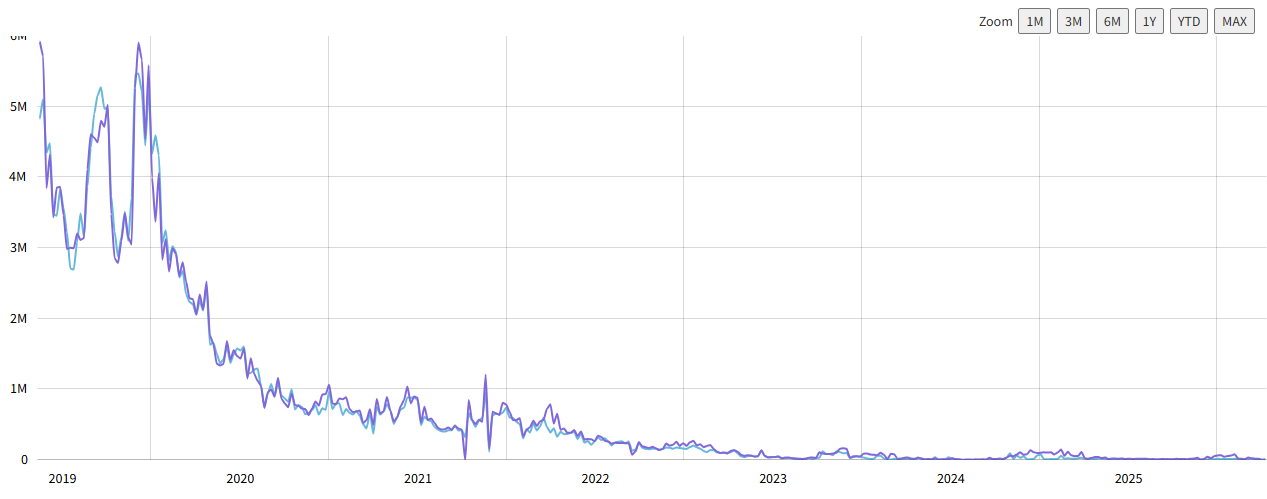
In early 2019, the KOTO network was running at 6 million hashes per second. Today it runs at roughly 20,000 hashes per second. That's a 99.6% drop in seven years.
Most people would look at that chart and call it a dead coin. I'd argue it's the opposite — it's a coin that survived exactly as designed.
Here's the story of how KOTO went from GPU farm target to the most accessible CPU-mined privacy coin on the planet, and why that matters in 2026.
The Gold Rush (2018–2019)
KOTO launched in December 2017 as a Japanese privacy coin — a Zcash fork running on the yescrypt algorithm, maintained by a small community of Japanese developers. The idea was simple: a privacy coin that ordinary people could mine on home hardware. No ASICs. No data centers. Just your CPU.
For about six months, it worked.
Then the GPU miners arrived.
yescrypt was already known to be GPU-mineable, and KOTO's growing community made it a target. Mining farms pointed their NVIDIA rigs at the network. Hashrate exploded from a few hundred kilohashes to millions. Block difficulty shot up. The home miners who were supposed to be the foundation of the network found themselves competing against industrial hardware.
This is the classic story of every mineable coin. Bitcoin went through it. Litecoin went through it. Monero is still fighting it. A coin launches with idealistic CPU-first goals, GPU miners flood in, ASICs eventually follow, and the original vision of decentralized home mining dies.
KOTO's developers saw it coming and made a deliberate choice.
The Algorithm Answer
The fix was yescryptR8G.
The "R8G" designation means the algorithm uses 8 times the memory of standard yescrypt. This isn't arbitrary — it's a specific engineering decision to exploit the fundamental difference between how CPUs and GPUs handle memory.
A CPU has relatively slow but large, flexible cache memory. It's designed for tasks that require accessing many different memory locations unpredictably. A GPU has fast but narrow memory bandwidth — optimized for doing the same simple operation on thousands of data points simultaneously.
yescryptR8G's memory requirements are specifically tuned to saturate GPU memory bandwidth while leaving CPU cache architecture relatively comfortable. The algorithm essentially asks: "Can you access a large, unpredictable set of memory locations quickly?" GPUs are bad at this. CPUs are good at it.
The result: a GTX 1070 that might dominate on SHA-256 or Ethash gets no meaningful advantage over a modern CPU on yescryptR8G. The power draw difference makes it actively worse — a GPU consuming 150W delivers similar hashrate to a CPU consuming 35W.
mofumofu.me, the main Japanese KOTO pool, still documents GPU mining with the old ccminer-yescryptr8g binary. It technically works. But the last update to that miner was in 2019, it requires CUDA 10.0, and the efficiency numbers make it a bad investment compared to just buying a better CPU.
The Exodus
When GPU miners realized yescryptR8G had specifically engineered away their advantage, most left.
The ones who stayed weren't there for profit. They were there because they believed in what KOTO was trying to do — private, CPU-accessible, Japanese-community-owned cryptocurrency.
Network hashrate crashed from 6 million H/s to under 100,000 H/s by 2020, and continued falling as speculators moved on to shinier opportunities. By 2025 the network was sitting at around 20,000 H/s — a tiny fraction of its peak.
But here's what that number actually means: the 20,000 H/s that remained is almost entirely CPU miners. Real people, running real hardware, in their homes and on their desks. The GPU farm operators are gone. The profit chasers are gone. What's left is the community the coin was designed for.
What 20,000 H/s Looks Like in 2026
To understand how small this network is, consider what it means in practice.
A Raspberry Pi 5 — an $80 single-board computer that draws 5-8 watts of power — produces roughly 1,000 H/s on yescryptR8G. That's approximately 5% of the entire KOTO network hashrate. One Raspberry Pi, sitting on your desk, consuming less power than a phone charger, holds a meaningful share of an entire cryptocurrency network.
I launched koto.isekai-pool.com last week. Within hours of connecting an i9-14900F desktop, my pool was finding two out of every three blocks on the entire KOTO blockchain. Not because I had some massive mining operation — because the network is small enough that a gaming PC running for an afternoon becomes the dominant miner on the planet.
This is either a bug or a feature depending on how you look at it. I think it's a feature.
The Philosophical Argument for Small Networks
Every major cryptocurrency eventually centralizes. Bitcoin mining is dominated by a handful of pools and a few large operations in low-electricity regions. Ethereum (pre-merge) was the same. Even Monero, the gold standard for CPU mining, has seen its hashrate increasingly concentrated.
KOTO chose a different path. By making GPU mining inefficient and keeping the network small, they preserved something rare: a coin where an individual with commodity hardware has a genuine, non-trivial share of the network.
This has real consequences for decentralization. When hashrate is distributed across hundreds of individual CPU miners running RPi5s and old laptops, there's no single point of failure. No pool can pull 51% of hashrate without significant hardware investment. No nation-state can shut down mining by targeting a few large facilities.
It also means something for the people mining it. When a Raspberry Pi 5 finds a block on KOTO, that's a real event. You contributed meaningfully to the network's security. You weren't one of 10,000 miners all getting a tiny slice of a pool's output based on your 0.001% share. You found a block.
The GPU Question in 2026
Can you still GPU mine KOTO? Technically yes — the ccminer-yescryptr8g binary still exists, mofumofu.me still documents it, and a modern NVIDIA GPU will produce some hashrate.
Should you? Almost certainly not.
The efficiency math doesn't work. An RTX 4080 consuming 320W might produce 50,000-80,000 H/s on yescryptR8G — roughly 3-5x better than a CPU at 5x the power draw. The H/s per watt calculation heavily favors the CPU. For a coin where the entire network is 20,000 H/s, you'd also be a destabilizing force — a single GPU farm could overwhelm the network in a way that makes mining less meaningful for everyone else.
More fundamentally, GPU mining KOTO in 2026 is philosophically at odds with what the coin is trying to be. It works against the design intent of yescryptR8G. It's the same impulse that drove the 2019 hashrate spike — using superior hardware to extract value rather than contributing to the network's original vision.
The Japanese KOTO community chose to make a CPU coin. Respecting that choice means mining with a CPU.
Where This Leaves Us
KOTO's 99.6% hashrate drop is not a failure story. It's a pruning story.
What got pruned was speculative GPU mining with no connection to the coin's values. What survived is a community of CPU miners, a working blockchain, a functional privacy coin, and a network small enough that individual participation is still meaningful.
In 2026, as major cryptocurrencies become increasingly industrial and inaccessible to individual miners, KOTO represents something genuinely different: a coin where your Raspberry Pi matters. Where a Sunday afternoon with a gaming PC makes you the #1 miner in the world. Where the design of the algorithm itself is a statement about what kind of network this is supposed to be.
That's not a dead coin. That's a coin that held its ground.
The Infrastructure Gap
One thing the pruning left behind was English-language infrastructure. The GPU miners who left took most of the Western documentation, guides, and community with them. The KOTO ecosystem that survived is almost entirely in Japanese.
That's the gap I'm trying to fill with isekai-pool.com.
- koto.isekai-pool.com — Public KOTO mining pool, 1% fee, no registration
- explorer.isekai-pool.com — Block explorer (official explorers went offline)
- isekai-pool.com/koto-network.html — Historical network tracker
- r/KotoCoin — English community on Reddit
The long-term vision connects to GameGlass.live — a payment widget for game developers that accepts CPU-mined coins directly. CPU miners earn KOTO with nowhere to spend it. Indie game developers need payments without app store cuts. These problems solve each other.
But that's a story for another post.
For now: if you have a Raspberry Pi, an old laptop, or a desktop you leave on anyway — point it at KOTO. You'll be contributing to a network that earned its small size honestly.